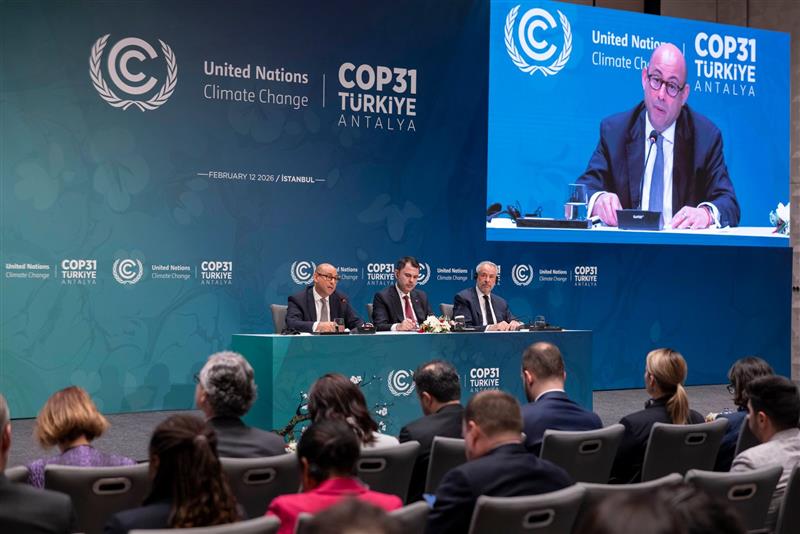
When UN Climate Change Executive Secretary Simon Stiell addressed journalists in Istanbul on 12 February alongside Türkiye’s COP31 and COP30 Presidents, his message was clear: “We find ourselves in a new world disorder. This is a period of instability and insecurity. Of strong arms and trade wars. The very concept of international cooperation is under attack.” Yet Stiell argued that “climate action can deliver stability in an unstable world.”
The next UN Climate Change Conference, COP31, scheduled for 9-20 November 2026 in Antalya, Türkiye, arrives at a moment of significant geopolitical fragmentation. As we documented after Davos 2026 and the Munich Security Conference, climate action is competing with security concerns and economic pressures for governments globally. On top of that, the US withdrawal from the Paris Agreement and UNFCCC has removed the major historical emitter (presently, China is the N.1 emitter of greenhouse gases) and major diplomatic player from the formal climate process. Against this backdrop, the road to Antalya is bumpy but paved with crucial meetings, conferences, and climate weeks throughout 2026 that could help build momentum towards COP31 for the conference to deliver beyond the most pessimistic outlooks.
Istanbul: Setting the Stage for Implementation
The recent Istanbul preparatory meeting brought together Türkiye, Australia, the UNFCCC accompanied by leadership from the last two COP presidencies (Brazil and Azerbaijan) to establish the COP31 vision. Stiell emphasised that the world is entering a “new era of implementation in climate action, focused on delivering concrete outcomes through partnerships, finance and accelerated action across economies and societies.”
Murat Kurum, COP31 President-designate and Minister of Environment, Urbanisation and Climate Change of the Republic of Türkiye, stressed that Türkiye and Australia “will work as one body with an understanding based on consultation and cooperation. We are all aware that the world’s expectations from COP31 are high. Our responsibility is to read these expectations correctly, to build trust among the parties and to produce results.”
Under the agreed governance structure, Türkiye will host COP31 and hold the formal presidency, while Australia’s Climate Minister Chris Bowen will serve as President of Negotiations with exclusive authority in relation to the negotiations. “Working together, Australia, the Pacific and Türkiye will deliver real progress for global climate action through COP31 in Türkiye and Pre-COP in the Pacific,” Minister Bowen said via video message.
The Pacific will host a Pre-COP in 2026, giving Small Island Developing States a platform before the main conference to put the spotlight on the needs and expectations from the most vulnerable island states.
COP30 Unfinished Job: Brazil’s Parallel Process
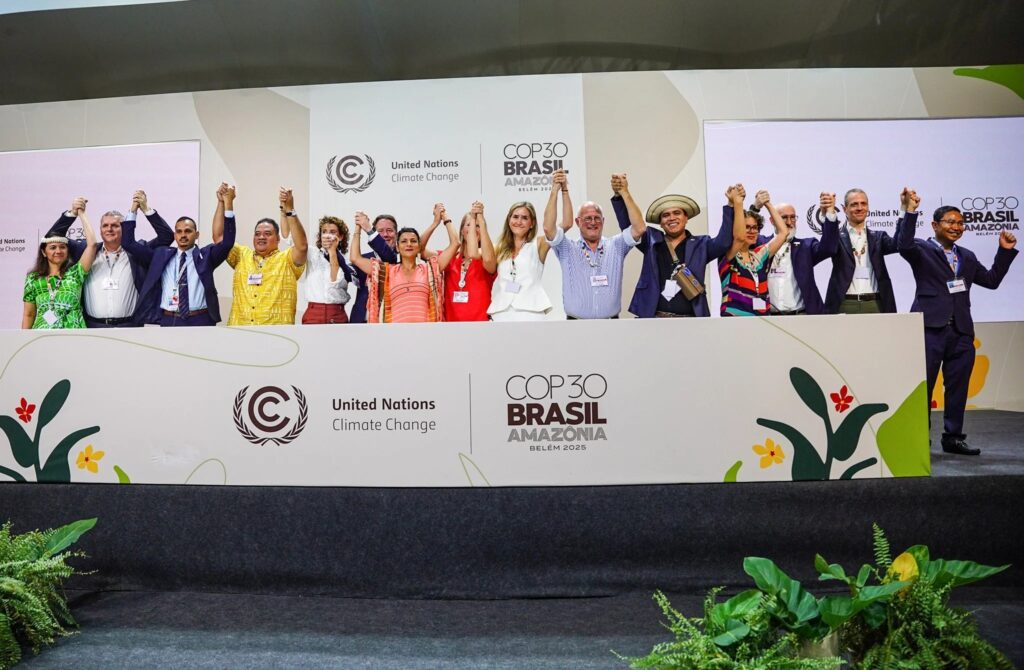
COP31 inherits critical unfinished business from COP30, which took place last November in Belém, Brazil. When consensus proved impossible on including a formal fossil fuel phase-out roadmap in the official COP text, blocked by major oil-producing nations. COP30 President André Corrêa do Lago announced then an alternative to keep the ball rolling in a different field: two voluntary roadmaps to be developed outside the formal UN process and presented at COP31.
“We don’t want to add to divisions. On the contrary, we want to prepare a document that unites countries around what was already agreed in Dubai,” Corrêa do Lago told journalists in Paris in February, in reference to the UAE Consensus outcome after COP28 in 2023 the final decision agreed called on countries to “transitioning away from fossil fuels in energy systems, in a just, orderly and equitable manner, accelerating action in this critical decade, so as to achieve net zero by 2050 in keeping with the science.”
The two roadmaps proposed by Brazil (one on transitioning away from fossil fuels, another on halting and reversing deforestation) will be based on technical studies, including proposals already commissioned by the COP30 Presidency, with input from the International Energy Agency, IRENA, and even the OPEC.
The Santa Marta Moment: April’s Critical Gathering
The first major test to determine whether nations are serious about transitioning away from fossil fuels (which are the first driver of climate change) comes on 24-29 April in Santa Marta, Colombia, with the First International Conference on Transitioning Away from Fossil Fuels, co-hosted by Colombia and the Netherlands. This conference aims to advance discussion on “equitable timelines” and “financial support” for a fossil fuel phase-out and will feed into Brazil’s roadmap development.
COP30 President Corrêa do Lago has indicated Brazil will request countries to submit suggestions on roadmap content in the coming weeks, with a final version likely presented at pre-COP31 meetings in October. The Colombia conference represents an opportunity for the approximately 80 countries that supported fossil fuel roadmaps at COP30 to demonstrate coalition momentum.
Climate Weeks 2026: Connecting Negotiations to Implementation
In the meantime, two Regional Climate Weeks will serve this year as important stepping stones between the Santa Marta conference and COP31 from a technical implementation perspective:
- Climate Week 1 (Yeosu, Republic of Korea, 21-25 April)
- Climate Week 2 (Baku, Azerbaijan, 5-9 October)
Beyond the Regional Climate Weeks, London Climate Week (21-29 June) and Climate Week NYC (20-27 September) will convene business leaders, investors, and civil society to advance sectoral commitments and private sector engagement ahead of COP31.
Other Critical 2026 Stepping Stones
Several other gatherings will influence the road to Antalya:
- G7 Summit (Évian, France, 15-17 June): With climate and environment expected on the agenda alongside energy security and critical minerals, the G7 will test whether major economies can maintain climate ambition amid competing priorities.
- UN Climate Talks (Bonn, 8-18 June): The annual mid-year negotiations will continue discussions on the Global Goal on Adaptation, unresolved at COP30, and hold the first trade-climate dialogue.
- G20 Summit (Miami, 14-15 December): Scheduled after COP31, the US-hosted G20 has indicated focus on “unlocking affordable energy” and “pioneering new technologies,” with climate’s place on the agenda uncertain given the host’s priorities.
What COP31 Must Deliver
The pathway from Belém to Antalya is dense with opportunities and obstacles. Success at COP31 will depend on whether these stepping stones build genuine momentum or simply create more processes and political declarations.
UN climate chief Simon Stiell has been clear about the stakes: “By 2028, we must be on track to meet those commitments” made at COP28 Dubai, doubling energy efficiency, tripling clean energy by 2030, transitioning away from fossil fuels, strengthening resilience. “So that countries come to COP33 confident of a robust response that delivers not just survival but strength: boosting resilience, growing economies, and slashing emissions.”
Cover photo: Coastal view of Antalya, Türkiye. Photo by Erik Karits/Pexels
Authorship: 10 Billion Solutions – Climate and sustainability communication
You are invited to use and reproduce this article published under Creative Commons license CC BY. This license allows you to reuse the work, but credit must be provided in all cases to 10 Billion Solutions.