Prepare for interviews, media appearances and events
Climate and sustainability communication has become an increasingly sought-after, but also more demanding, skill set. It is no longer enough to ‘know about climate’ or have general experience in communication. Organisations are looking for people who can translate complexity, build credible narratives and communicate under pressure, whether in a job interview, in front of the media or moderating an international event.
If you work in communications or want to specialise in climate communication, this article is for you.
Climate communication: a professional specialisation (not an extra)
For years, communication about climate change has been treated as a complement. Today, it is a specialisation in itself, with very specific challenges:
- Informed and critical audiences
- Polarised political and media contexts
- The need for rigour without losing clarity
- Little room for error in interviews, panels or public statements
That is why more and more professionals are asking themselves:
- How do I focus my career on climate communication?
- How do I prepare for an interview on sustainability or climate?
- What do recruiters really expect?
- How do I speak to the media without resorting to empty or alarmist messages?
The answer is not to accumulate more information or repeat generic formulas. It is to develop criteria, strategy and professional practice applied to real contexts.
Understanding what to say, how to say it and when to say it has become a key skill for those working in communication, climate and sustainability, and this is precisely where many profiles need support, training and specific guidance.
Preparing for job interviews on climate and sustainability: what makes the difference
In interviews for positions in sustainability, institutional communication or climate, it is not only your experience that is evaluated: it is how you think, how you structure messages and how you react to difficult questions.
This is where many technical profiles or generalist communicators get stuck.
“I contacted Mariana at very short notice and she was very flexible in helping me prepare for a job interview. It was a very valuable session. She has a deep understanding of the humanitarian sector and quickly understood what I was looking for.”
Oyuki Ang Anaya, former Head of Field Unit, UNHCR
Preparation is not about memorising answers, but rather:
- Clarifying your professional positioning
- Anticipating complex questions
- Adjusting your discourse to the institutional context
- Gaining confidence without losing authenticity
This type of work is precisely the focus of 10 Billion Solutions’ microconsulting: short, highly specific sessions aimed at unblocking real situations.
Speaking to the media: a critical (and trainable) skill
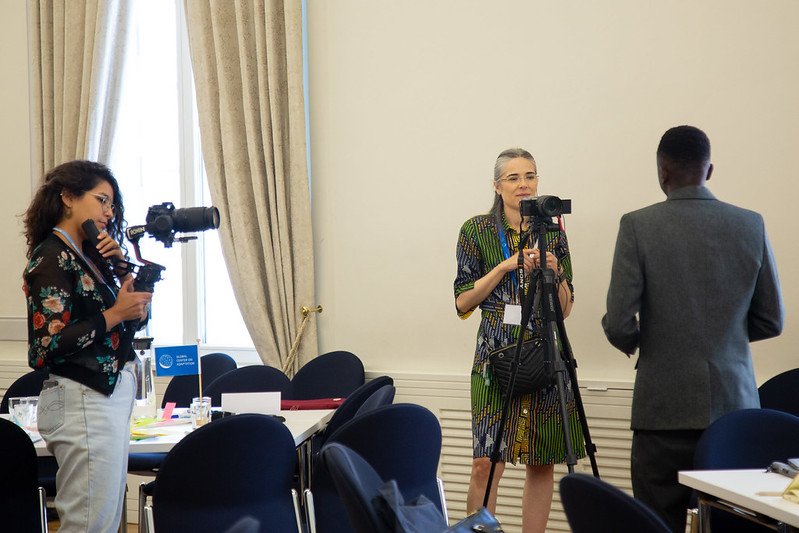
Appearing in the media, giving interviews or publicly representing a climate organisation is one of the moments of greatest professional exposure. It is also one for which one is least trained.
The most common mistake is to think that it is enough to ‘tell the truth’ or ‘master the subject’. In reality, speaking to the media requires:
- Clear key messages
- Ability to synthesise
- Handling uncomfortable questions
- Control of verbal and non-verbal language
“Mariana demonstrated a wealth of knowledge, was very engaging and provided constructive feedback in a clear and encouraging manner. I particularly liked her ability to break down key points and make the sessions interactive.”
Stella Shumba, Senior Research Associate, UNU-EHS (media training)
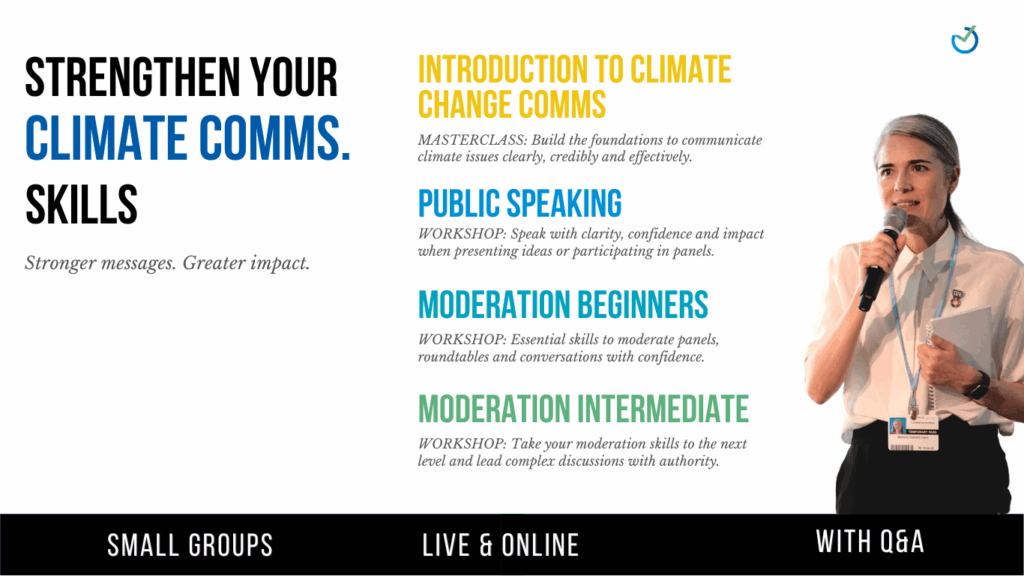
That is why, within the 10 Billion Solutions Academy, media training, together with our moderation training, are the most in-demand courses among communication and sustainability professionals.
Managing and moderating climate panels and events: leadership through communication
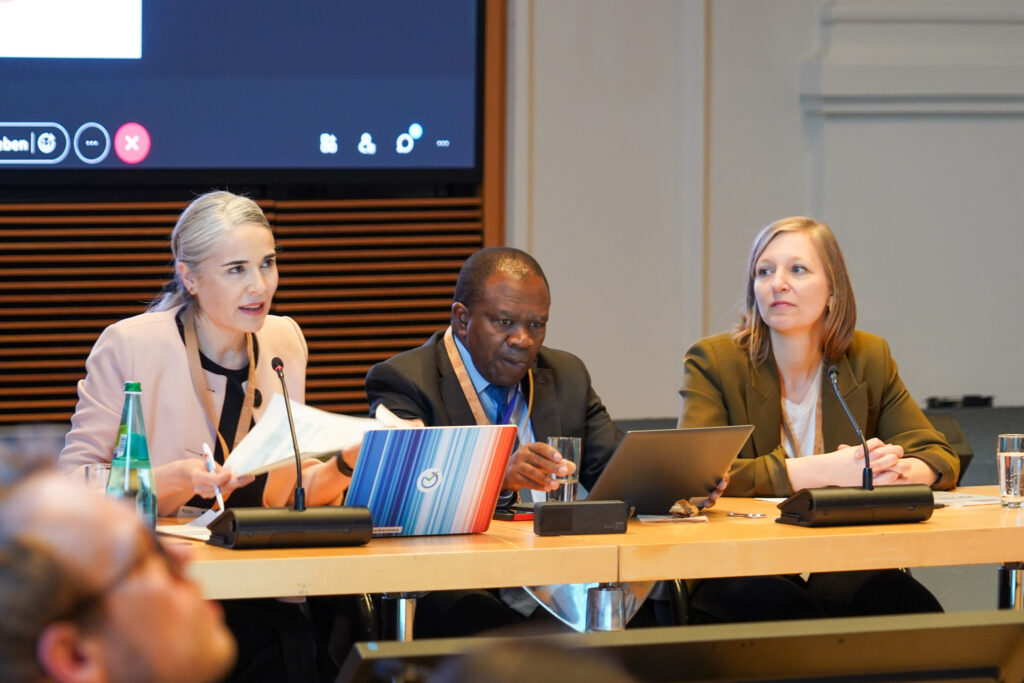
Moderation and facilitation at events on climate and sustainability are not operational or neutral tasks. They are a strategic communication function. In contexts where technical experts, policy makers, businesses and civil society coexist, the moderator not only allocates speaking time, but also defines the framework of the dialogue, the level of depth and the real usefulness of the conversation.
Good moderation can turn a panel into a space for clarity and progress. Bad moderation can turn it into a succession of disconnected messages that are overly technical or irrelevant to the audience. That is why good moderation is a form of communicative leadership.
‘Mariana’s experience and guidance allowed me to approach the event with confidence and authenticity.’
Salim Stokey, Global Centre on Adaptation
In practice, whoever moderates a climate or sustainability event:
- Sets the tone of the debate, establishing from the outset whether the conversation will be strategic, technical, political or informative, and preventing it from drifting into generic discourse or defensive positions.
- Organises the conversation, helping speakers to structure their interventions, connecting ideas and prioritising messages that add value, especially when time is limited.
- Avoids empty or overly technical messages by rephrasing questions, asking for specific examples and acting as a bridge between expert knowledge and a diverse audience.
- Protects the credibility of the event by ensuring consistency between the objectives of the meeting, the guest profiles and the messages that are ultimately conveyed, which is especially critical in international and multi-stakeholder spaces.
Good moderation requires preparation, active listening, the ability to synthesise and good communication skills. It is not improvisation. It is a skill that can be trained and, in the field of climate and sustainability, makes a clear difference in the perception and impact of any event.
‘Mariana’s support for our participants and the three-day event was very dynamic and provided fantastic resources.’
Thomas André, Director of Operations, REN21
Moderation is, in itself, an advanced form of strategic communication, especially in international and multi-stakeholder contexts.
Learn, practise and ask for help (when it makes sense)
All of this can be very useful for you if you are:
- Preparing for a key interview
- About to speak to the media or moderate an event
- Rethinking your professional positioning
- Looking for a job in climate communication
Climate communication: a skill that can be trained
Climate communication is not about talking more, but about talking better, making strategic decisions under pressure, and building long-term credibility. And that, like any serious professional skill, can be trained.
You don’t need generic solutions. You need specific guidance, applied to your real context.
That’s where the key resources of 10 Billion Solutions come in. If you want to take the next step, you can:
- Explore our microconsulting
- Join our free community on Whatsapp, where you’ll find job offers, resources, networking opportunities, and more.
- Check out the Academy’s resources and personalised training courses.
- Subscribe to our newsletter and follow us on social media, such as LinkedIn.
Masterclass: Introduction to Climate Communication
Communicating about climate change is much more than just conveying scientific information. In a context marked by misinformation, public scepticism and increasingly polarised debates, knowing how to structure clear, credible and strategic messages is no longer an optional skill, but a key competence for professionals working in climate, sustainability or institutional communication.
That is why we are launching the masterclass Introduction to Climate Change Communication, a one-hour training session designed to give you tools you can apply from day one. Through this experience, we address essential topics such as:
- How to translate complex climate change issues into messages that really connect with different audiences.
- Why many climate messages do not resonate and how to improve them.
- How to manage narratives in polarised environments or where there is low trust in experts and institutions.
- Strategies for communicating clearly without sacrificing accuracy.
The session includes a presentation and a live Q&A, allowing you not only to understand the concepts, but also to apply them and resolve real questions in real time.
If you are interested in improving your climate communication (whether for your daily work, campaigns, presentations or content), you can find more information and register for the next session here.
Terms and Conditions here.