A New Civilizational Narrative is Reshaping the Debate
The Munich Security Conference that concluded on Friday was billed as a moment to confront global fragmentation. Under the theme “Under Destruction,” world leaders convened in the Bavarian capital to assess threats to the rules-based international order. Climate change, a quintessential global threat, was present in side events and declarations but it was strategically absent from the conference’s main narrative arc.
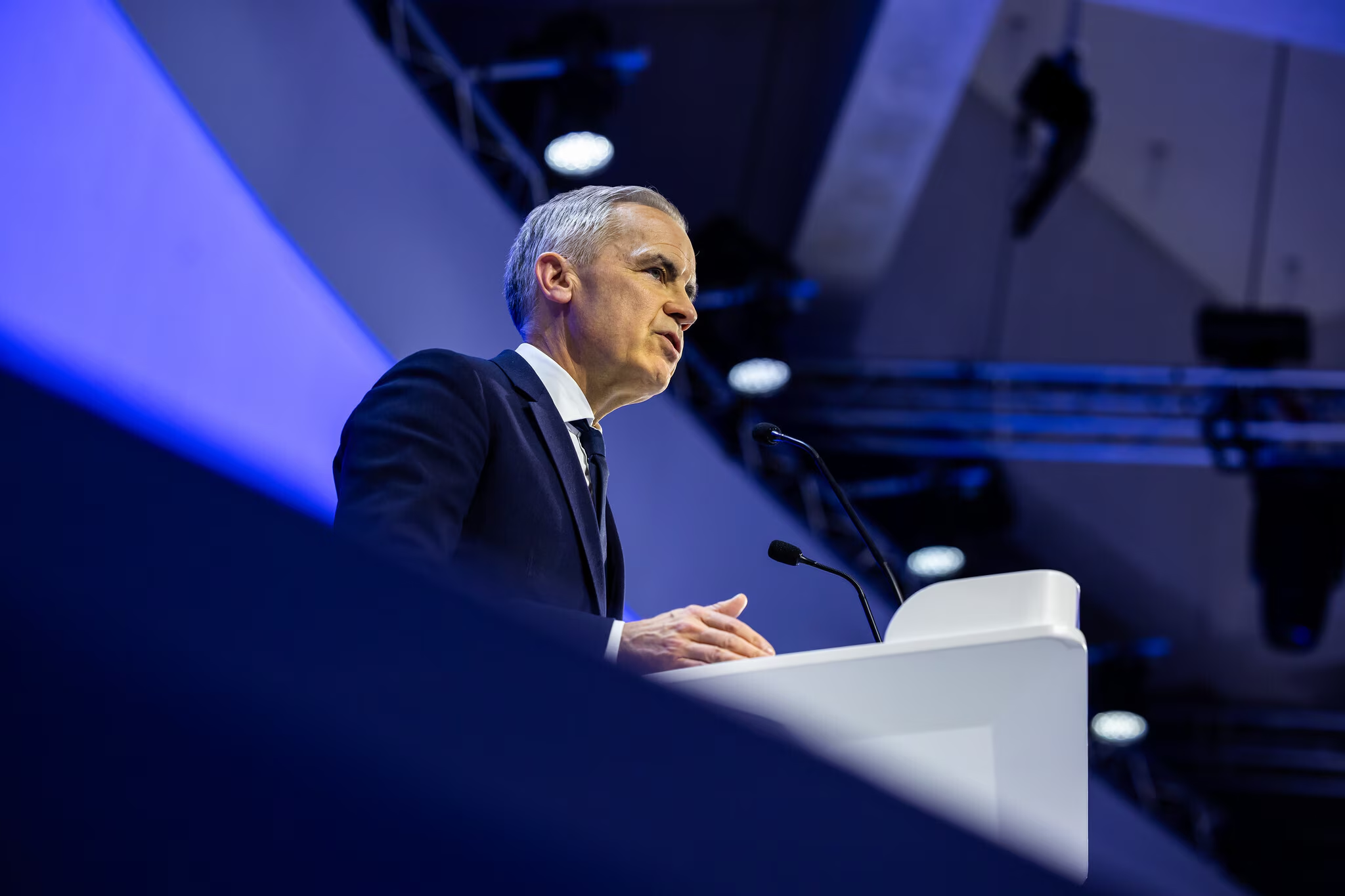
More revealing still was the language used by the most prominent American voice in the room: U.S. Secretary of State Marco Rubio. His speech didn’t just sideline climate action, it reframed the entire debate in civilizational terms, casting climate policy as part of a misguided ideology that weakens Western competitiveness and security.
For climate and sustainability communicators, Munich 2026 wasn’t a setback. It was a diagnostic signal about the narrative battleground ahead.
The Climate Paradox: Present But Peripheral
Climate featured at Munich 2026, but not where power was being negotiated. California Governor Gavin Newsom (Democrat) led a panel titled “Playing With Fire: The Need for Decisive Climate Action,” announcing climate cooperation agreements with Germany, Ukraine, Spain, and Qatar. German Environment Minister Steffi Lemke emphasized the climate-economy-security nexus. These weren’t trivial moments.
Yet climate remained conspicuously absent from the conference’s main stage, where geopolitical rivalry, transatlantic tensions, and the future of NATO dominated. Chatham House analysts noted that climate was a “blind spot” at MSC 2026, a pattern we’ve now seen twice in as many months, following Davos 2026, where climate was reframed through competitiveness and risk rather than moral imperative.
The signal is clear: in forums where security elites set agendas, climate is increasingly treated as one issue among many, not the convening crisis.
Rubio’s Civilizational Framing: A New Narrative Front
The most consequential climate moment at Munich 2026 wasn’t about climate at all. It was Secretary of State Marco Rubio’s address, which explicitly attacked what he called the “climate cult” and positioned climate action as antithetical to Western prosperity and security.
Rubio’s speech was a masterclass in reframing. He argued that Western civilization faces existential threats, not from climate change, but from adversaries like China and Russia, and from internal weaknesses including “radical climate policies” that undermine energy independence and industrial competitiveness. He framed climate action as a luxury Western societies can no longer afford in an era of great power competition.
This wasn’t throwaway rhetoric. Rubio was articulating a coherent counter-narrative: that climate policy is not a security asset but a strategic liability; that renewables weaken rather than strengthen energy security; and that Western nations must choose between climate virtue-signaling and civilizational survival.
This language of civilizational endeavor, of defending “our way of life” against external enemies and internal delusions, is gaining weight in some Western capitals. It’s no longer confined to think tanks, industry associations or fringe voices. It’s now the official U.S. position, delivered by the Secretary of State at the world’s premier security forum.
The Institutional Void: California Steps In, Washington Steps Out
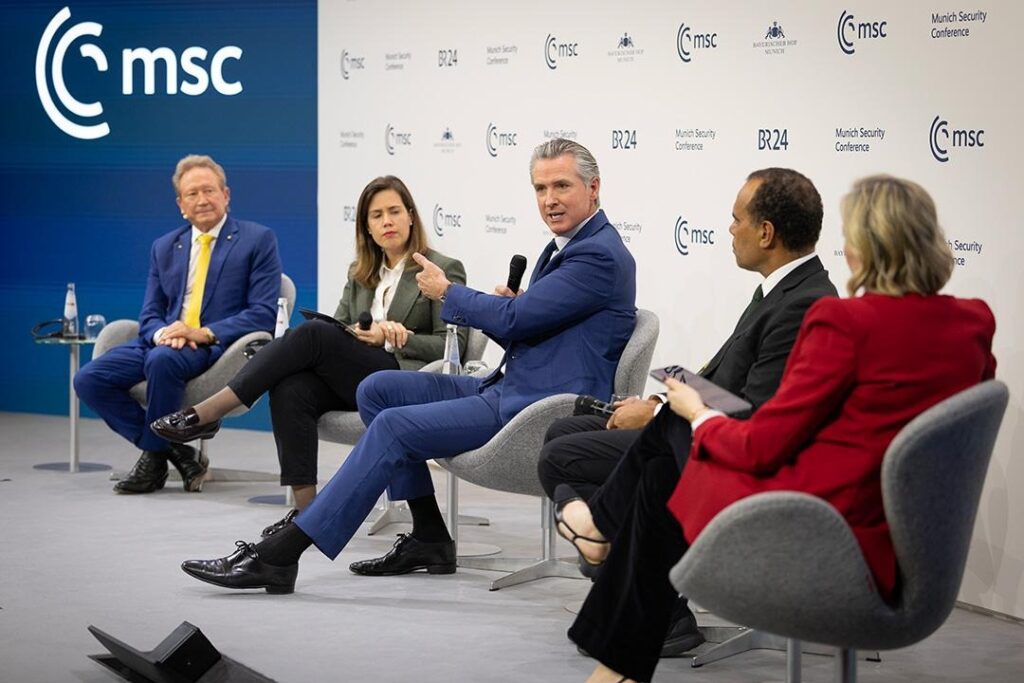
Newsom’s prominent role at Munich 2026 underscored a fundamental shift. With the U.S. federal government having withdrawn now from the Paris Agreement, the UNFCCC, and dozens of other international climate bodies, subnational actors are now filling the diplomatic void.
California’s climate agreements with Germany, Ukraine, Spain, and Qatar signal the emergence of what we’ve called “plurilateral climate action”, cooperation that bypasses traditional multilateral architecture and relies instead on coalitions, bilateral deals, and issue-specific partnerships. This is climate diplomacy in a fragmented world.
The risk is that this model lacks the scale, accountability mechanisms, inclusivity and universal participation that made frameworks like the Paris Agreement credible. The opportunity is that plurilateralism can move faster, adapt to geopolitical realities, and build trust through delivery rather than consensus declarations.
What Munich Teaches About the Narrative Shift
Munich 2026 confirms a pattern that began at Davos: climate action is being reframed, or attacked in some cases, through the language of national interest, economic competitiveness, and civilizational resilience. The moral case for climate action (“because it’s the right thing”) is losing traction in rooms where decisions get made.
Three narrative dynamics are now dominant:
- Climate-as-risk: Leaders care about climate when it’s framed as a threat to infrastructure, supply chains, insurance markets, and fiscal stability, not when it’s framed as an ethical imperative.
- Climate-as-liability: The counter-narrative (epitomized by Rubio) positions climate policy as a self-inflicted wound that weakens Western competitiveness, energy security, and industrial capacity.
- Climate-as-plurilateral: With multilateral institutions under siege, climate cooperation is increasingly organized through coalitions, regional blocs, and bilateral arrangements, less universal, more transactional.
Five Communications Takeaways for Climate and Sustainability Leaders
Munich 2026 offers clear lessons for how to communicate climate action in a fragmented, security-first world:
- Lead with resilience, infrastructure, and economic stability. Climate messaging must connect to risks boards and governments already prioritize: supply chain disruptions, energy affordability, fiscal exposure to extreme weather, and industrial competitiveness. Don’t lead with emissions targets.
- Acknowledge the civilizational framing, then reframe it. Rubio’s narrative positions climate action as weakness. The counter-narrative must position climate inaction as the real strategic liability: rising adaptation costs, infrastructure failures, resource conflicts, and economic fragility. Make the case that resilient, diversified energy systems strengthen sovereignty and security.
- Build a proof stack for every claim. In a contested information environment, climate claims are challenged in real time. Every assertion must be backed by verifiable evidence: scope, assumptions, boundaries, and delivery metrics. Publish receipts: what changed in operations, capex, procurement, and resilience, not just future promises.
- Don’t wait for multilateral grand narratives. The institutional architecture that enabled Paris is weakening. Your communications strategy must work even when the UN lane stalls. Show credible progress through multiple channels: regulation, markets, coalition commitments, and operational delivery.
- Anticipate and pre-bunk predictable attacks. The “climate cult” framing isn’t going away. Address constraints and trade-offs upfront. Acknowledge costs, timelines, and transition risks. Build trust by naming what’s hard, not just what’s aspirational.
The Path Forward
Munich Security Conference 2026 was not a failure for climate action. It was a reality check. Climate is no longer the default organising principle of international cooperation. It’s one agenda among many, and in some rooms, it’s actively contested.
For climate and sustainability communicators, this isn’t defeat. It’s clarification. The narrative terrain has shifted. Success now depends on communications that perform under volatility: geopolitical shocks, institutional retreat, and fast-shifting risk perceptions.
At 10 Billion Solutions, we help organizations translate climate ambition into influence-ready strategy, building narratives that work when multilateralism stalls, framing that connects to immediate decision constraints, and evidence architectures that withstand scrutiny. The goal isn’t to win the climate debate. It’s to ensure climate action continues even when the debate turns hostile.
Authorship: 10 Billion Solutions – Climate and sustainability communication
You are invited to use and reproduce this article published under Creative Commons license CC BY. This license allows you to reuse the work, but credit must be provided in all cases to 10 Billion Solutions.
Cover image: Secretary Marco Rubio delivers remarks to the Munich Security Conference in Munich, Germany, February 14, 2026. (Official State Department photo by Freddie Everett)