Between 17 August and 2 December 2026, at least seven important climate and sustainability convenings will compete for your attention: UNCCD COP17 in Mongolia, Baku Climate Week, Climate Week NYC, Munich Climate Week, CBD COP17 in Armenia, COP31 in Türkiye, and STEP by Pollutec in Paris. This is a rundown of all seven and for each there is the one question you should answer before deciding whether each one deserves your organisation’s time, budget and exposure.
Two weeks from now, the climate and sustainability calendar resumes. UNCCD COP17 opens in Ulaanbaatar, Mongolia, on 17 August, and from there the season does not really stop until the end-of-year break. Inboxes and social media threads fill with side events and pavilion invitations, programme releases, even sponsorship decks,…
A tsunami of engagement opportunities emerges, and FOMO (Fear Of Missing Out) starts to build. Don’t let yourself get overwhelmed. Part of our job is to counter that FOMO and the instinct across the sector to fall for every nudge for attention. Being everywhere it humanly and institutionally impossible, and it is not even advisable from a strategic and reputational point of view. So sit back, keep reading and relax!
Over the years we have been advising organisations before and during high-profile climate and sustainability moments, and we keep seeing the same pattern: teams build an events calendar before they build an events strategy. They decide where to show up before they decide what for. The result is a season of expensive appearances that produce some panel photos, many selfies and a bunch of LinkedIn posts, but not outcomes.
These are some of the top climate and sustainability events coming up in Q3-Q4 and some questions you should ask yourself before deciding if and how to engage:
1. UNCCD COP17, Ulaanbaatar, Mongolia — 17 to 28 August. Land desertification and drought open the season, under the theme Restoring Land, Restoring Hope. It is the entry most organisations skip, and often the one most relevant to food security and migration work. The question: are you ignoring land and drought because they are not “your” issue, or because no one has made the case for why they should be?
2. Baku Climate Week, Azerbaijan — 7 to 11 September. The UNFCCC’s own mid-year forum, built to connect negotiated outcomes to implementation. Smaller and more technical than the past regional climate weeks. The question is how instrumental is your organisation in the implementation issues being discussed in that meeting?
3. Climate Week NYC — 20 to 27 September, running alongside the UN General Assembly’s High-Level Week. This is probably the biggest climate (umbrella) event after the UNFCCC COPs (although London Climate Action Week is gaining momentum) but it has also quite expensive and events are very scattered across the city; also access to the main programme events (hosted by the Climate Group) is difficult because of very high demand. This year, Climate Week NYC and UNGA will be the last for António Guterres as UN Secretary-General, with the process to choose his successor (hopefuly a woman, finaly) now in full swing ahead of the handover on 1 January 2027. The question is: is your target audience and potential strategic partner going to be sitting at the same event you are attending or speaking in NY or could you hold this over a Teams or 1:1?
4. Munich Climate Week — 19 to 25 October. A first! 10 Billion Solutions is a partner of the first ever Munich Climate Week and Mariana Castaño Cano is a special advisor to the organising team. Hundreds of events around the city connecting institutions, business, science, start-ups and civil society. We are very proud to contribute and we will keep you posted. Are you based or operating in Munich and Bavaria? If the answer is yes, get involved.
5. CBD COP17, Yerevan, Armenia — 19 to 30 October. This is the biodiversity sister of the climate COP, and the first full review of progress against the Kunming-Montreal Global Biodiversity Framework. You can hardly be involved in the three Rio Convention COPS (UNFCCC, CBD and UNCCD); the question: which one actually is more critical for your mandate?
6. COP31, Antalya, Türkiye — 9 to 20 November. Eleven days, dozens of thousand people joining or following the negotiations, the Leaders’ Summit and the wider climate ‘expo’. The question: is your delegation there to negotiate, to observe as a qualified observer, to truly advance imprementation or just be seen? If the reason is one of the first three, do you have a clear and impactful strategy or will you be closer to running around like a headless chicken?
7. STEP by Pollutec, Paris — 1 to 2 December. A first edition, and an ambitious one: a new European event on industrial decarbonisation and circular economy. 10 Billion Solutions is proudly working with Consultancy32 and RX Events with the programme and press relations. Reach out if you want to get involved in a serious value proposition for the decarbonisation and circularity journey of your organisation and company.
IMPORTANT: Organising and participating at events during these conferences come with a cost. Every appearance costs staff time, travel budget, and the opportunity cost of the work not done while your team away. Then there is the cost organisations underestimate most: reputational exposure. A poorly prepared appearance is remembered for longer than no appearance at all.
This is the shift you and your organisation need to make in 2026: move from an events checklist to an events strategy. Not “which pavilions can we afford,” but “which two or three moments actually serve our mandate, and what do we need to have ready for each one.” Who is my target audience, are they there, what are my strategic goals, what I have to say and how, what is the cost and the reputational risk and opportunity cost, etc. Before you jump into any logistic or agenda designing question you should have answered all the above.
If you are organising or joining an event, be mindful of the missed opportunity this could turn out to be. We have watched panels lose their audience to speakers and a moderator who could not engage the room or make sense of the topics discuss. We also see often that strong expensive-to-produce content go unreported because no one was capturing it as it happened. Coverage and moderation are not add-ons to your event strategy but they are the difference between an event that gets remembered and one that gets forgotten by the next coffee break.
This is the work we do with clients ahead of a events like these ones. We sit with them and analyse the case for or against each event, then a communications and outreach plan for the ones that make the cut (audience, messages, format, speaking and moderation training, etc. That kind of advisory work is cheaper than a single poorly-prepared event.
Start preparing the event season now
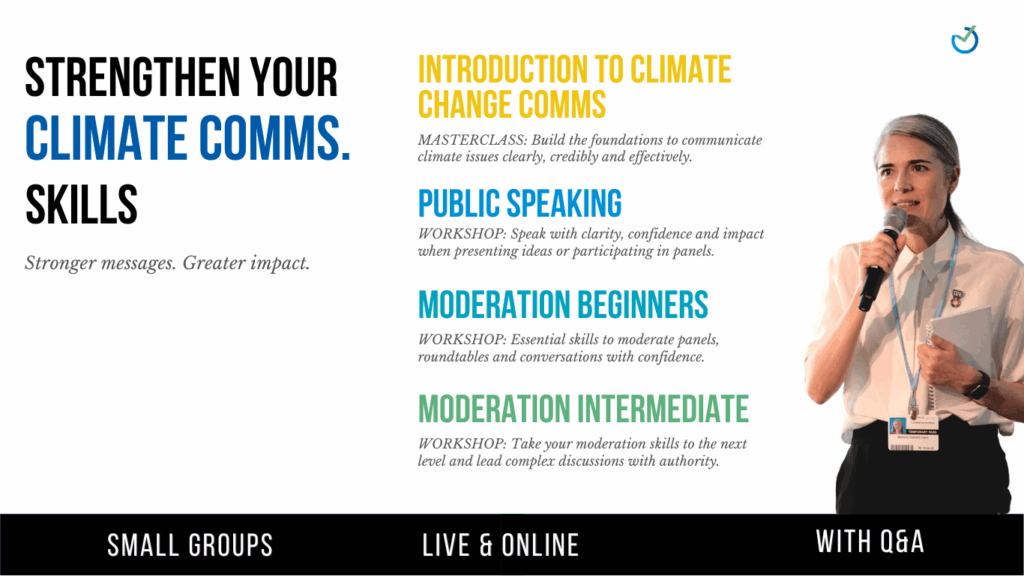
Beside the on-demand advisory support, this montg of August we offer three workshops (public speaking, moderation for beginners and moderation intermediate level) for small groups, capped at five participants. The workshops are built for people who will be on a stage or managing a room this season and want to walk in prepared, not improvising in front of a live or online audience.
If your organisation is weighing which of these eight moments is worth showing up for, and what showing up well should actually look like, that is the conversation we have with clients every year at exactly this point in the calendar. We would rather help you skip five events and land three, than help you attend eight and be remembered for none. Get in touch to talk through your upcoming events, or take a look at our moderation training if your team is heading into a room in the next four months.
August Moderation Workshops
August Public Speaking Workshop