2025 has been a record-breaking year, with weather extremes intensified by global warming, growing socio-economic impacts and clear signs that the climate crisis is already affecting the daily lives and development opportunities of most of the planet’s inhabitants.
To start 2026 informed, here are some key facts you should remember to understand the state of the climate and the challenges we face.
1. Human and economic impacts of extreme events
Extreme weather events continue to leave deep scars across the planet. Between 1993 and 2022, more than 9,400 extreme events (including floods, storms, heatwaves and droughts) were recorded, causing millions of human casualties and cumulative economic damage of more than £4.2 trillion.
In 2025, these trends continued, with extreme events hitting regions of Asia, Africa, America and Oceania, highlighting the vulnerability of communities, infrastructure and ecosystems to climate change.
- Displacement and loss of life
Extreme events caused the deaths of more than 765,000 people between 1993 and 2022, and millions more have been forcibly displaced.
In 2025, prolonged droughts, storms and hurricanes forced entire communities to abandon their homes, increasing food insecurity, water scarcity and socio-economic vulnerability, especially in developing countries and densely populated coastal regions.
- Storms and cyclones intensified by climate change
In 2025, cyclones and tropical storms affected Asia, Africa and Central America, intensified by warming oceans and increased humidity in the atmosphere. These phenomena caused extreme rainfall, destructive winds and storm surges, resulting in thousands of deaths and billions of dollars in property damage. The destruction of critical infrastructure, loss of crops and disruption of livelihoods demonstrate how climate change amplifies the impacts of natural events.
2. Temperature records, heat waves and scientific evidence
Pending confirmation, 2025 is likely to be one of the warmest years on record, part of a streak of abnormally warm years this century. Global average temperatures are well above pre-industrial levels, increasing the frequency of heatwaves, fires, droughts and floods, and generating direct impacts on health, agricultural production and ecosystems.
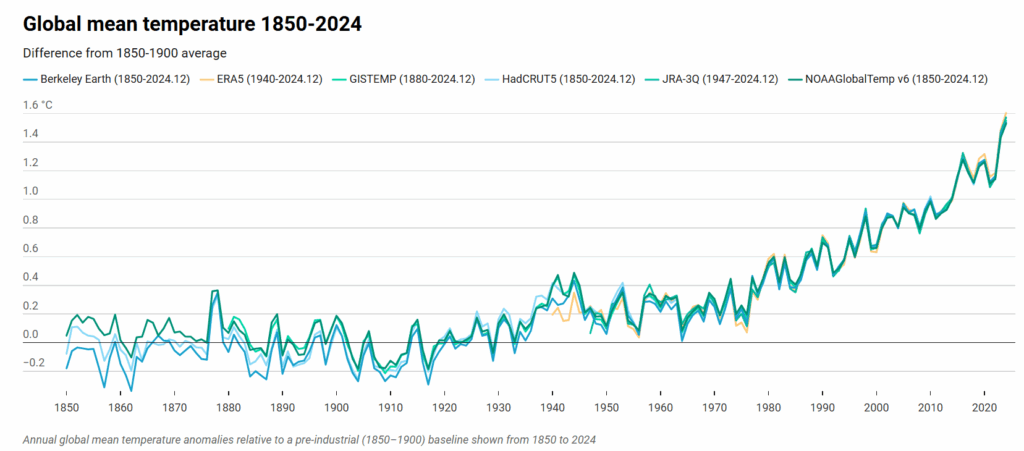
Scientific evidence confirms that some changes induced by warming may be irreversible, reinforcing the urgency of coordinated and ambitious global climate action.
- Arctic warming and glacier loss
The Arctic is warming more than twice faster than the global average, with massive sea ice loss and accelerated glacier retreat worldwide, from the Alps and Andes to Canada and the Himalayas. This affects the availability of fresh water for hundreds of millions of people, alters hydrological patterns and threatens the biodiversity associated with these ecosystems.
- Warmer oceans intensify extreme precipitation
Ocean warming has increased the atmosphere’s capacity to retain moisture, leading to torrential rains and more intense extreme events. This not only increases the risk of flooding, but also impacts coastal ecosystems, infrastructure and the food security of millions of people.
- Impacts of extreme heat waves
In 2025, extreme heat waves affected all regions of the world, from Europe to Africa and Asia. These record temperatures affected public health, reduced agricultural productivity and caused thermal stress in fragile ecosystems, showing how global warming consistently amplifies extreme events.
3. New climate plans until 2035
In 2025, several countries presented renewed climate plans with targets up to 2035, reinforcing commitments to reduce emissions, invest in renewable energy, and adapt to extreme events. These plans reflect an increase in international climate ambition and represent concrete steps towards global coordination, strengthening resilience, and protecting communities and ecosystems from the impacts of climate change.
4. Positive developments: energy transition and climate solutions
Although the challenges are enormous, 2025 also saw encouraging progress. For the first time, renewable energy generated more electricity than coal globally, driven by growth in solar and wind power (see the Ember 2025 report). In addition, innovation in electric mobility, energy efficiency and carbon capture technologies accelerated, showing that concrete tools exist to reduce risks and move towards a sustainable future. These advances confirm that, although the crisis is serious, it is possible to take action and generate positive impact.
5. The United States and the weakening of multilateralism
In 2025, the decisions of Donald Trump’s administration were a factor of instability for international climate governance, with direct attacks on climate multilateralism, questioning of science and clear signs of a boycott of climate action, as well as the announced withdrawal from the Paris Agreement, the UN Framework Convention on Climate Change and many other environmental and climate agreements.
The US government is impeding domestic action on climate change and eroding international trust, weakening climate finance and pushing other governments to lower their ambition. In a context of increasing impacts and scientific urgency, the lack of leadership or negative leadership of a key power such as the United States poses a systemic risk to the collective ability to respond effectively to the climate crisis.
Authorship: 10 Billion Solutions – Climate and sustainability communication
You are invited to use and reproduce this article published under Creative Commons license CC BY. This license allows you to reuse the work, but credit must be provided in all cases to 10 Billion Solutions.